
Submission Preparation Checklist
Author Guidelines
1. The Structure and Content of the Article
The requirements for the structure and content of the article correspond to the provisions of the National Standard of Ukraine DSTU 7152:2020. Edition. Formatting publications in journals and collections and EASE Guidelines for Authors and Translators of Scientific Articles to be Published in English.
ARTICLE COMPONENTS
- UDC index.
- Digital Object Identifier (DOI).
- Information about the author(s).
- Title of the article.
- Abstract.
- Keywords.
- The main text of the article.
- Information about the contribution of the authors.
- Acknowledgments, funding sources.
- References.
- Dates of submission, review and accepted for publication.
UDC INDEX
The index of the UDC is located in the top left hand corner of the page.
Information and bibliographic department of the Maksymovych Scientific Library provides paid services for determining the UDC index (UAH 25 per index). The service can be received in the off. 24 of the library, or call: (044) 239-33-53 (33-53), or email to bibliograflib@gmail.com (the email should contain your name, last name, position, the title and abstract of the article).
DIGITAL OBJECT IDENTIFIER (DOI):
- is assigned by the journal publisher;
- is placed in a separate line under the UDC index.
INFORMATION ABOUT THE AUTHOR(S)
The order of authors must be determined before submitting the manuscript (see the Authorship and Сo-authorship section). Any changes made after manuscript submission must be approved by all authors. Information about the author should include the following elements:
- first name, last name;
- doctoral degree, academic title;
- ORCID ID unique identifier of the research author;
- corporate email of the author(s);
- affiliation during the research (name of the institution or organization), city, country.
Authors should indicate their affiliation as provided on their institution's official website. Please use your official corporate email when communicating with the journal's editors.
Abbreviations of doctoral degrees, academic titles and positions in Ukrainian and English are requested to be submitted in accordance with Table 1.
Table 1
Abbreviations of doctoral degrees, academic titles and positions
|
in Ukrainian |
in English |
|
in Ukrainian |
in English |
|
in Ukrainian |
in English |
TITLE OF THE ARTICLE
It should be understandable to specialists in other fields, informative and specific: 5–9 words corresponding to the content of the article, without phrases such as "Research on the issue of...", "Some issues...", "Problems..." etc.
For an original research article, it is preferable to add a study descriptor to the title, for example, "cross-sectional study", "practical study", "survey results" (see more details on title requirements in the EASE Guidelines for Authors and Translators of Scientific Articles to be Published in English.
NOTE! Authors submit two versions of the article:
- with information about the authors (file Authors. Title of the article);
- without information about the authors (file For review. Title of the article). This is required for double-blind peer review.
ABSTRACT
The abstract should reflect the content of the article, as it will be the primary source of information about your research for most readers (many databases contain only the title and abstract).
The abstract of an original research article should be structured and informative, comply with the IMRAD structure and contain the following sections:
- Background (actuality, objectives and tasks).
- Methods.
- Results.
- Conclusions.
See the abstract example in the manuscript template and the abstract requirements in the EASE Guidelines for Authors and Translators of Scientific Articles to be Published in English and "Writing an Effective Abstract. A Study Guide" by Allan Gaw.
The abstract length of an original research article should not be less than 1,800 characters and not more than 2,500 characters (with spaces).
The abstract of a review article can be unstructured and indicative; it should reflect the main theses of the review.
The abstract length of a review article could be 100–150 words.
KEYWORDS
For an original research article — 4–8 keywords.
For a review article — 3–6 keywords.
Keywords should not repeat the title of the article.
THE MAIN TEXT OF THE ARTICLE
The main text length for:
- an original research article — from 3,000 to 8,000 words;
- a review article — from 2,000 to 5,000 words.
Structure of the article.
An original research article should be prepared using the IMRAD structure and contain the following basic elements:
- Introduction.
- Methods.
- Results.
- Discussion and conclusions.
Detailed requirements for each of the specified structural elements of the article are given in the EASE Guidelines for Authors and Translators of Scientific Articles to be Published in English.
A review article should also be prepared using the IMRAD structure without the "Methods" section.
Figures, tables. All figures (schemes, graphs, charts, etc.) and tables should be numbered with Arabic numerals and placed directly in the text, where they should be according to the content (and not at the end of the document).
Each figure should be accompanied by a caption (centered below the figure). Each table should be accompanied by a title (centered above the table). Captions and titles should reflect the content of figures and tables, be concise and informative. Each figure or table should be referred to in the main text of the article and their serial number should be indicated, for example: (Fig. 1), (Table 2).
Example: 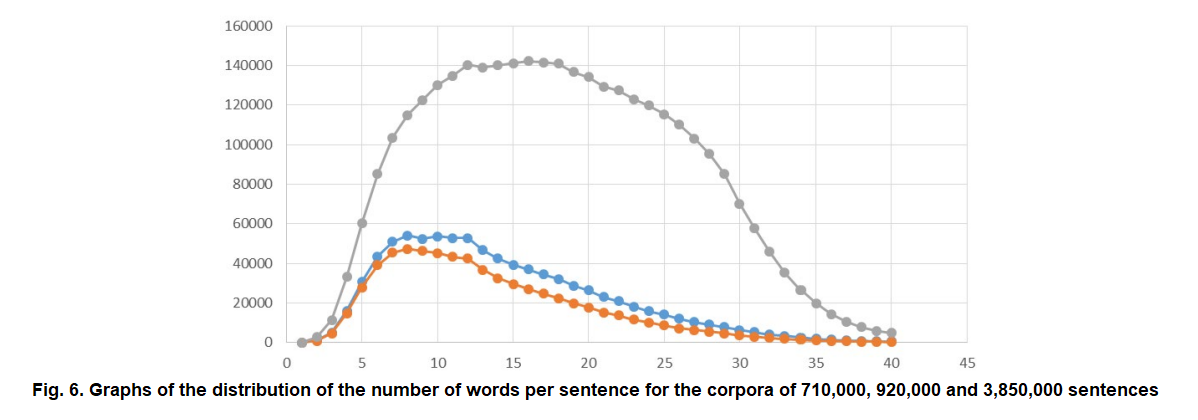
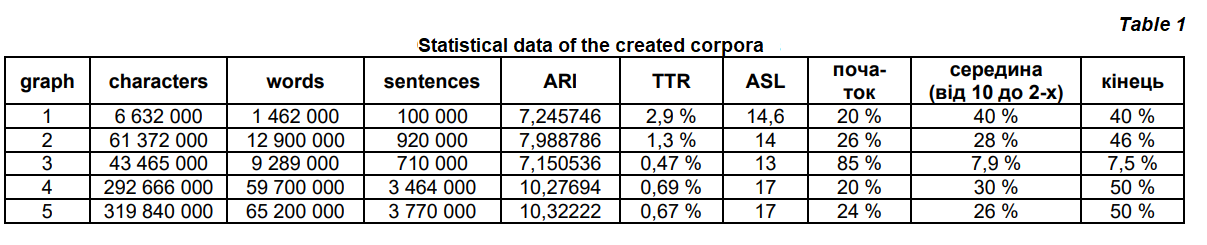
If the article is accepted, authors will upload separate files of all high-resolution figures in .tif or .jpg formats. File names for infographics should be self-explanatory and match the names in the text (eg Figure 1, Figure 2). Image resolution: 1,200 dpi for line art, 600 dpi for grayscale and 300 dpi for color.
INFORMATION ABOUT THE CONTRIBUTION OF THE AUTHORS
It is necessary to indicate information about the contribution of the authors to the preparation of the article according to CRediT (Contributor Roles Taxonomy):
- Conceptualization. Ideas; the formulation or evolution of overarching research goals and objectives.
- Formal analysis. Application of statistical, mathematical, computational or other formal methods for analysis or synthesis of empirical research data.
- Software. Programming, software development; design of computer programs; implementation of computer code and auxiliary algorithms; code component testing.
- Methodology. Development or design of methodology; creating models.
- Data validation. Checking the reproducibility of results / experiments and other research results.
- Writing — an original draft. Writing the initial version (draft) of the article.
- Writing — revision and editing. Making significant changes and additions to the article.
Example:
First name, last name — conceptualization, methodology;
First name, last name — software, formal analysis;
First name, last name — data validation, writing — original draft;
First name, last name — writing — revision and editing.
ACKNOWLEDGMENTS, FUNDING SOURCES
Mention all people who have made significant contributions to the research but are not co-authors: coordinated the execution of the research activities, provided resources (research materials, instruments, computing resources or other analysis tools).
Specify all sources of funding. Recommended format: "This work was supported by the Strategic Research Council (grant number xxxx)". If there was no specific funding, write the following sentence: "This research received no specific grant from any funding agency in the public, commercial, or not-for-profit sectors" (see more details on p. 3 EASE Guidelines for Authors and Translators of Scientific Articles to be Published in English).
REFERENCES
References are formatted using the APA referencing style (7th Edition).
Reference list entries are arranged alphabetically without numbering.
A DOI (if available) must be provided for each source.
The article in ENGLISH provides ONE reference list — References, in which the reference list entries that are not in Roman script (Cyrillic, Arabic, Chinese, etc.) are given in English translation. Include the source language in English, enclosed in square brackets ([in Ukrainian], [in Chinese], etc.) and followed by the reference in the source language, enclosed in square brackets, at the end of the reference list entry. Example:
- Zhenchenko, M. (2019). Digital transformation publishing industry (2nd ed). Zhnets [in Ukrainian]. [Женченко, М. (2019). Цифрові трансформації видавничої галузі (2-ге вид). Жнець].
The article in UKRAINIAN provides TWO reference lists:
- Reference list in original language (references are formatted using the APA referencing style).
- Reference list in English (references are formatted using the APA referencing style), in which the reference list entries that are not in Roman script (Cyrillic, Arabic, Chinese, etc.) are given in English translation. Include the source language in English, enclosed in square brackets ([in Ukrainian], [in Chinese], etc.), at the end of the reference list entry. Example:
- Zhenchenko, M. (2019). Digital transformation publishing industry (2nd ed). Zhnets [in Ukrainian].
Format for IN-TEXT REFERENCES. In-text references should be cited inside round brackets including:
- the author's last name (for sources with one author) or the first few words of the title followed by three full stops (for sources with no author), the year of publication and, if necessary, the page numbers (preceded by the abbreviation "p." in English or "c." in Ukrainian), separated with commas:
- (Freeberg, 2019), (Freeberg, 2019, p. 147), (Freeberg, 2019, pp. 56–57), (Scientific heritage…, 2017, p. 45), (Правдивий, 2018, с. 184–185);
- all authors' last names (for sources with no more than three authors):
- (Dormus, Brown & Bloom, 2013);
- only the first author's last name followed by the abbreviation "et al." or "та ін." (for sources with more than three authors):
- (Grady et al., 2019), (Назаренко та ін., 2022);
- the author's last name followed by initials (for sources published in the same year by different authors with the same last name):
- (Reinberg Т., 2005);
- the author's last name and the year of publication of the first source followed by the year of publication of the next source (without repeating the author's last name for sources by the same author published in different years):
- (Gibson, 2007, p. 115; 2010, pp. 73–75);
- the author's last name and the year of publication with adding a lower case letter after the year (for sources by the same author published in the same year):
- (Gibson, 2005a; 2005b; 2005c);
- the number or heading (when there is no number) given in the online source for the particular section (volume, part, chapter, etc.) after the year of publication, separated with a comma (if there are no page numbers):
- (Brown, 2017, vol. 2).
Multiple in-text references, cited at the same time, should be arranged alphabetically by the first letter of the author's last name or by title, when there is no author, and separated with semicolons. For example, researchers studied a certain problem: (Freeberg, 2019; Grady et al., 2019).
The main part of the references in the article should be to authoritative sources published during the last 5–7 years. The reference list should consist of at least 30 % of articles published in the top journals that are indexed in Scopus and Web of Science. Self-citation should not exceed 15 % of the total number of cited sources.
APA reference list EXAMPLES
Book
Author, A. A. (Year). Title of book. Edition.
- Covey, S. R. (2013). The 7 habits of highly effective people: Powerful lessons in personal change. Simon & Schuster.
Include the DOI or URL at the end of the reference list entry for e-books or books available online:
- Svendsen, S., & Løber, L. (2020). The big picture/Academic writing: The one-hour guide (3rd digital ed.). Hans Reitzel Forlag. https://thebigpicture-academicwriting.digi.hansreitzel.dk/
- Brück, M. (2009). Women in early British and Irish astronomy: Stars and satellites. Springer Nature. https:/doi.org/10.1007/978-90-481-2473-2
Journal Article
Author, A. A. (Year). Title of article. Title of Journal, Volume number(Issue / Part number), Page number(s). DOI / URL
- Grady, J. S., Her, M., Moreno, G., Perez, C., & Yelinek, J. (2019). Emotions in storybooks: A comparison of storybooks that represent ethnic and racial groups in the United States. Psychology of Popular Media Culture, 8(3), 207–217. https://doi.org/10.1037/ppm0000185
Conference Presentation
Author, A. A. (Year, Month, Day of conference). Title of presentation [Conference presentation]. Title of conference, Place of conference. URL
- Evans, A. C., Jr., Garbarino, J., Bocanegra, E., Kinscherff, R. T., & Márquez-Greene, N. (2019, August 8–11). Gun violence: An event on the power of community [Conference presentation]. APA 2019 Convention, Chicago, IL, United States. https://convention.apa.org/2019-video
Author, A. A. (Year). Title of conference paper. In Editor(s) (Ed./Eds.), Title of conference (Page numbers). Publisher. DOI / URL
- Saidi, D. (2008). Typology of motion event in Tunisian Arabic. In M. Kokkonidis (Ed.), Proceedings of LingO 2007 (pp. 196–203). Faculty of Linguistics, Philology and Phonetics, University of Oxford.
Thesis / Dissertation
Author, A. A. (Year). Title of thesis / dissertation (Publication number, if any) [Doctoral dissertation, Institution]. Name of the database, repository or archive. URL
- Miranda, C. (2019). Exploring the lived experiences of foster youth who obtained graduate level degrees: Self-efficacy, resilience, and the impact on identity development (Publication No. 27542827) [Doctoral dissertation, Pepperdine University]. PQDT Open. https://pqdtopen.proquest.com/doc/2309521814.html?FMT=AI
Legal or Standards Documents
- International Organization for Standardization. (2018). Occupational health and safety management systems — Requirements with guidance for use (ISO Standard No. 45001:2018). https://www.iso.org/standard/63787.html
- Верховна Рада України. (2019). Про забезпечення функціонування української мови як державної (Закон України від 25.04.2019 р. № 2704-VIII). https://zakon.rada.gov.ua/laws/show/2704-19
You can also see detailed requirements and examples of reference list entries at:
- Publication Manual of the American Psychological Association (APA), 7th Edition;
- Reference Examples in APA (7th ed.).
Online referencing generators such as grafiati.com may be used for proper formatting reference list entries.
NOTE! The Maksymovych Scientific Library provides paid services for formatting and editing reference lists.
DATES OF RECEIVING AND EDITORIAL & PUBLISHING PROCESSING OF THE ARTICLE
At the end of the article, information is provided in the format:
Received:
Revised:
Accepted:
NOTE! Information about the author(s), the article title, abstract (at least 1,800 characters) and keywords in English for Ukrainian language articles or in Ukrainian for English language articles are provided at the end of the article after the reference list and the date of submission.
2. Formatting Guidelines
A manuscript should comply with formatting guidelines of the Publishing and Polygraphic Centre "The University of Kyiv", in particular:
1. The text should be submitted as a WinWord file (*.doc) or a TeX file without specifying a style.
2. Page setup:
- Line spacing – single;
- Format – А4;
- Margins:
|
Top |
2,54 |
Bottom |
2,0 |
|
Header from Top |
1,7 |
||
3. Font for the text in Oriental languages:
- SimSun for Chinese;
- MS Mincho for Japanese;
- Arial for Arabic, Persian and Turkish;
- Mangal for Hindi;
- Malgun Gothic for Korean;
- If the used font is not included with MS Windows, it should be submitted separately.
4. Article components formatting:
- UDC, DOI – Arial, 9 pt, bold;
- Information about the author(s) – Arial, 9 pt, bold;
- Title of the article – Arial, 10 pt, bold, UPPER CASE;
- Abstract (in Ukrainian and English) – Arial, 9 pt, italic;
- IMRAD sections ("Relevance"...) – Arial, 9 pt, bold italic;
- The main text of the article (including tables and figures) – Arial, 10 pt, regular;
- References – Arial, 8 pt, regular;
- Spacing between article sections – one line.
5. Additional guidelines:
- All abbreviations should be spelled out in full and introduced in round brackets the first time they are used in the text; only after an abbreviation has been defined like this, it can be used;
- All direct quotations should be provided in a manuscript language (whatever is their original language) and followed by the reference to the source and the exact page number;
- omissions within quotations are indicated by an ellipsis (three full stops) in square brackets: […];
- All equations in a manuscript should be typed using only an equation editor (Microsoft Equation or MathType Equation) in Arial, 11 pt font;
- a non-breaking space (Ctrl+Shift+Space) should be inserted between the numerical value and the measurement abbreviation (unit symbol);
- use the following graphic symbols: quotation marks "…", apostrophe …'…, dash … – … (use a short dash [–], not a long one [—] or hyphen [-]);
- the dash is used to indicate ranges (from… to…): pp. 95–97, 30s–40s, April – May, Kyiv – Lviv;
- avoid the substitution of Latin characters for Cyrillic ones and vice versa (eg Latin characters o, a, c, x, p, e, H, T, I, M, B for Cyrillic characters о, а, с, х, р, е, Н, Т, І, М, В), especially in the author's last name and first name, the article title, abstract, keywords and reference list entries, as it may cause incorrect indexing of paper and make it impossible to identify it in search engines and citation databases.